Blue Plaques
 Sheffield Home of Football has ambitions for a series of blue plaques around the city centre of Sheffield over the coming months and we are seeking funding to do so. These blue plaques highlight the people and places which made Sheffield famous for its unique footballing history. If you think there should be other people and places connected to football which should be commemorated, or you are interested in sponsorship, please get in touch with us.
- Outside the Crucible to mark the location of where the first rules were agreed by an association football club (Adelphi Hotel, 1858)
- 9 East Parade to mark the location of Nathaniel Creswick’s solicitors offices. Nathanial Creswick was co-founder of Sheffield FC.
- Norfolk Row (at the catholic cathedral side southern end of Norfolk Row) to mark the location of John Charles Shaw’s legal stationers shop. John Shaw was co-founder of Hallam FC & President of Sheffield FA when the Sheffield and FA rules were amalgamated in 1877.
- Town hall to recognize the achievements of the 3 England women’s footballers from Sheffield who won the Euros in 2020
- At the side of the Crucible to mark the location of the Garrick Tavern. Garrick FC are the oldest club to emerge from a public house (1866)
- Plaque to mark the oldest Catholic clubs in the world. Surrey Catholic FC and St Vincent’s FC.
- Outside Sterling Works on Arundel Street to mark the location of Lockwood Brothers FC, the oldest factory works team in the world.
- The York Hotel in Broomhill to mark the location of York FC the oldest hotel team in the world (1861)
- 53 Springbroom Lane to mark the residence of Charles Clegg
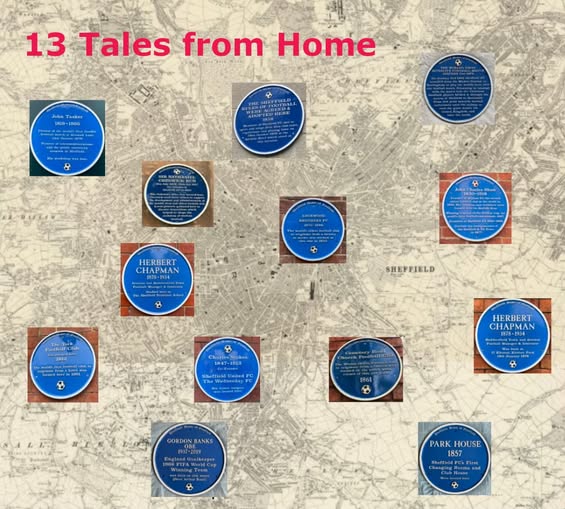
Here’s a google map showing where the plaques are situated
Existing plaques include
#1 Cemetery Road Church FC
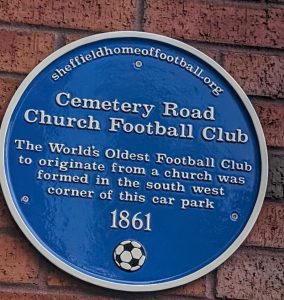 Our first plaque commemorates Cemetery Road Church FC, as the first football club in the world to originate from a church. It has been approved for erection on the spot where the club was founded in 1861, which is now the Nuffield Health Sheffield Fitness and Wellbeing Gym on Napier Street. The members of this world’s first club came from the Cemetery Road Congregational Church which was in the Porter Brook area of Sheffield close to Sheffield General Cemetery. The church unfortunately no longer exists, but its location was in the south-west corner of what is now the Nuffield Health gymnasium car park, on the corner of Cemetery Road and Summerfield Street. The very earliest known organised football clubs first originated from already organised sporting outfits, mainly cricket clubs.
#2 Sir Nathaniel Creswick
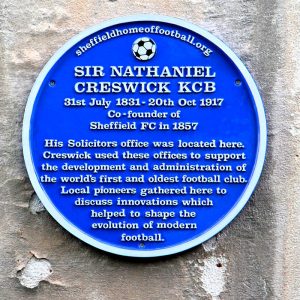 Our second blue plaque is located at 9 East Parade, Sheffield S1 2ET (next to Sheffield Cathedral on the right hand side). We are honouring Sir Nathaniel Creswick KCB whose solicitors offices were located here and which was used to draft the Sheffield rules and other important developments in the modern game of association football. We are grateful to Solicitors, Norrie Waite & Slater who currently occupy the offices and who have kindly sponsored the plaque and made a kind donation to our blue plaque project.
#3 The Original Rules
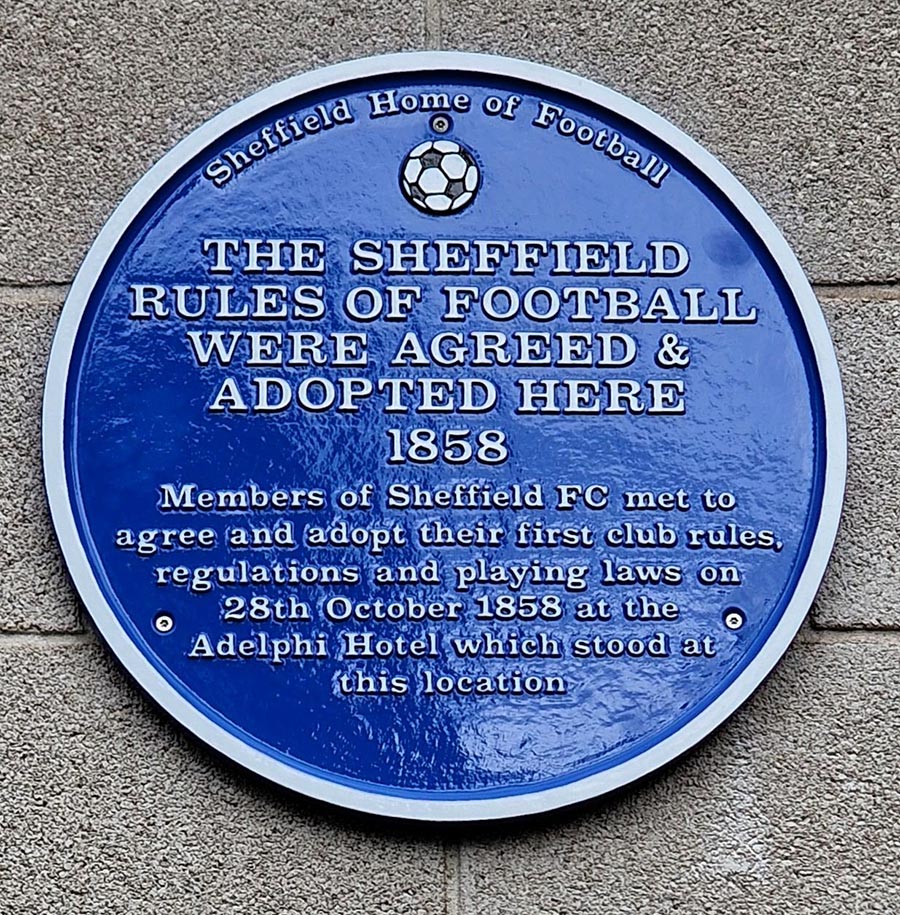
This is to commemorate the location (site of the former Adelphi Hotel) where the original Sheffield Rules of football were approved and launched on on 28th October 1858
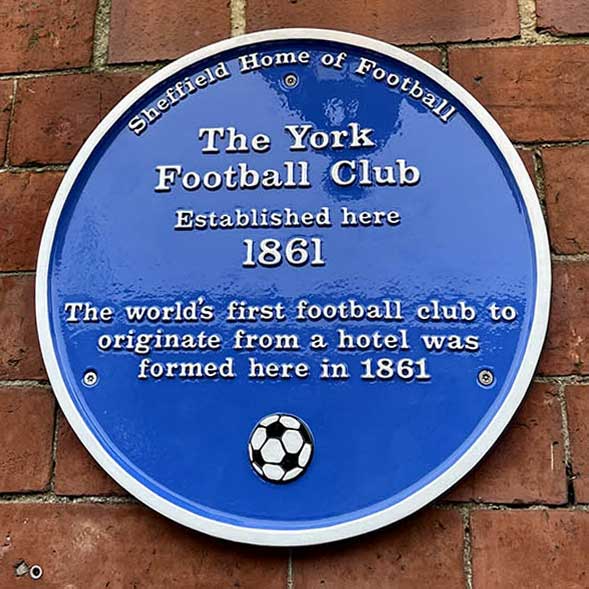
This plaque is to mark the origin location of the world’s first club to be established in connexion with a hotel or public house.
The York Athletic Sports & Football Club formed from the York Hotel in Broomhill, Sheffield in 1861. Like many early Sheffield clubs, they formed from the existing York Cricket Club also associated with the York Hotel. Their first President was none other than Sheffield FC founder Nathaniel Creswick. The club played games at Endcliffe Park but in late 1863 appear to be the victims of a bankrupt landlord (Mr Hield). We can find no match reports during 1864 or later.
A briefly lived but hugely important club since many now famous football clubs can trace their origins back to links with hotel or pubs. To name a few are, Liverpool, Chelsea, Sheffield Wednesday, Wrexham, Blackburn, Sunderland, Brentford & Ipswich.
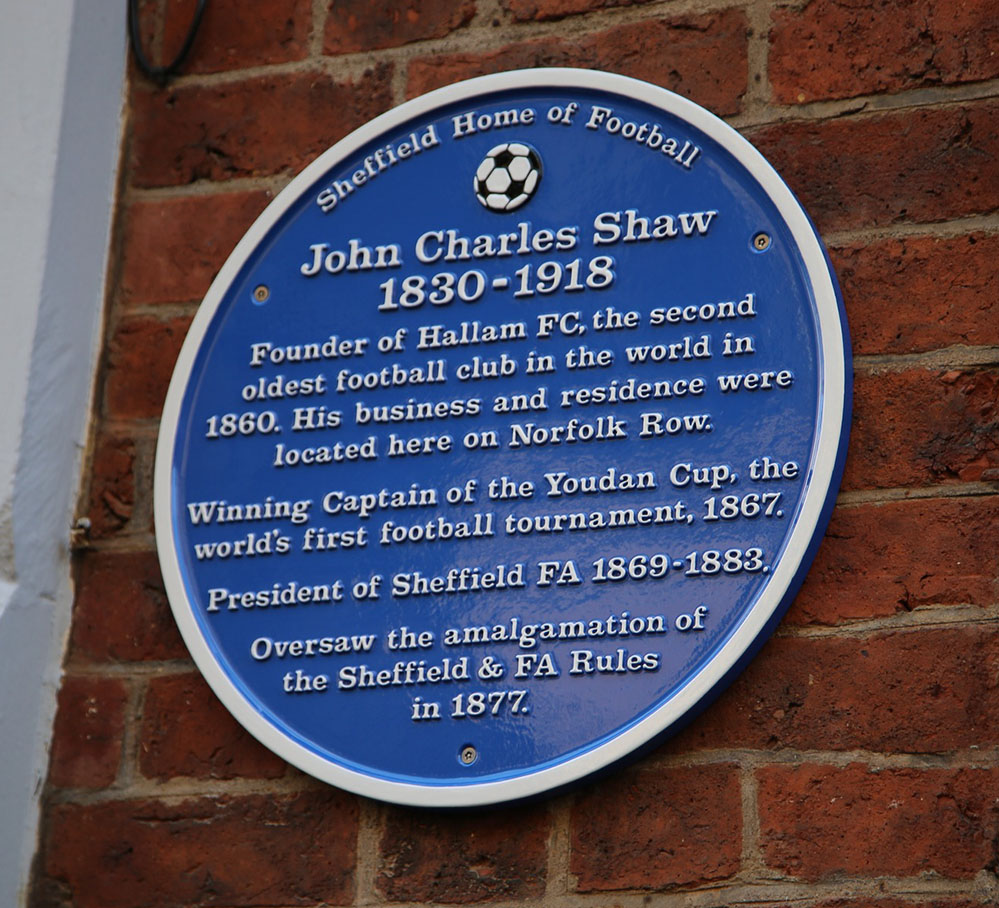
This plaque is located halfway up the west side of Norfolk Row in central Sheffield. This plaque is to recognise the achievements of early Penistone born Sheffield footballing pioneer John Charles Shaw. Shaw made multiple significant contributions to the development of early association football including being the worlds first football captain, co-founder of the world second oldest football club Hallam FC, the first ever player to lift a football tournament trophy the Youdan cup and president of the Sheffield FA went in 1877.
The Sheffield and the London FA rules were amalgamated into the unified footballing code we have today.
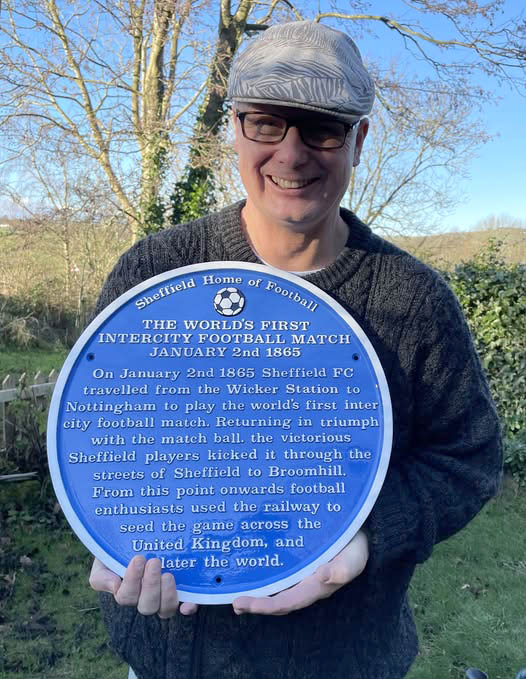
This plaque remembers the world’s very first away football match & first match ever played between 2 towns or cities. It’s located outside the Three Arches Events space on Walker Street next to the Wicker Arches.
On 2nd January 1865 Sheffield FC players returned home victorious to the Wicker Station having played this match in Nottingham against the club, which later become Notts County FC, Nottinghamshire FC. The match was played at The Meadows cricket ground, now the Queens Walk Recreation Ground in south Nottingham.
After returning from Nottingham, the jubilant Sheffield FC players kicked the match ball all the way from the Wicker and through the town up to Broomhill. Sheffield FC’s John Charels Shaw reportedly walked off home with the match ball.
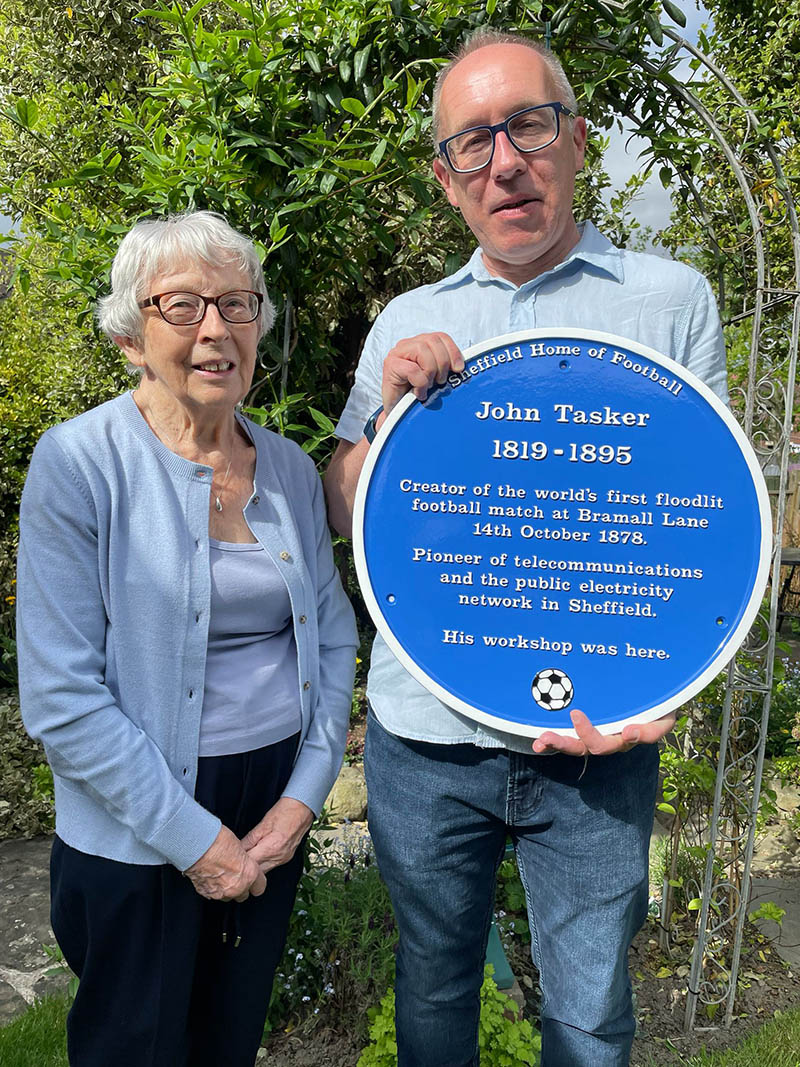
John Tasker was originally a boot and shoemaker, who turned his skills to engineering and telephony and founded the company, John Tasker Engineering Ltd, originally based on Division Street, Sheffield. The site is now the location of one of Sheffield city centre’s most popular pubs, the award-winning Frog & Parrot.
On the 14th of October 1878, John Tasker enabled the very first football match played under floodlights anywhere in the world using his electrical engineering expertise. We take watching football at night for granted now but it was Tasker who pioneered and made real the idea that we didn’t need to play football matches only before the sun set. Many top matches are now played at night. Internationals, the Champions League Final, ordinary league matches etc…
The match in October 1878 was played at Bramall Lane & between two elite Sheffield teams called ‘Reds’ and ‘Blues’. The crowd was reported as almost 20,000, many of whom turned up just to see the novelty of the floodlights which were far were more exciting than the match itself, which ended in a dull 0-0 draw. The four floodlights, powered by generators, sat on 30 foot high wooden stages and the publicity for the match proclaimed; “The Electric Light to be used for the illumination of the ground will be equal to 8,000 candles and will be supplied by Messrs Tasker & Co, of Sheffield”.
Thanks to John tasker, the world’s first floodlit football match goes down in history as yet another Sheffield world association football first.
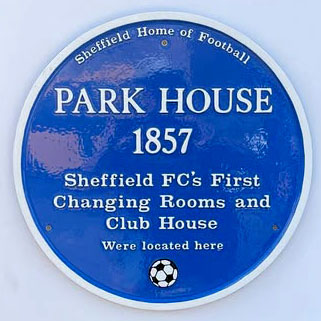
All organised football clubs need somewhere to change & meet. The world’s first modern football club, Sheffield FC was no different. When they formed in October 1857, they played at East Bank in Turners field adjacent to Mr Thomas Asline Ward’s house called PARK HOUSE. Nearby was the Creswick family home, East Hill House making getting to football for Nathaniel Creswick, the club’s co-founder an easy walk across East Bank Road.
The potting shed of PARK HOUSE became the nearby convenient space to form the world very first changing rooms & club house for a modern association football club. This was the age of very early football administration so being a potting shed the club members sometimes made use of the discarded potatoes lying around on the floor to ballot members or take votes during meetings held in there. For the first year of play at East Bank Sheffield FC’s club members experimented with various football rules, discussing their ideas of how to play the game in the potting shed & then putting them to practise out on the pitch besides Park House making this area the birthplace of modern association football. The world’s biggest sport’s conception location.
PARK HOUSE no longer stands as it did, but in 1857 it could be found located on the junction of Olive Grove Road and East Bank Road. MFH’s south yard & the northern end of the Sheffield College building now currently occupies the area where the house & garden once existed.
We believe the field the players ran out onto was directly south of Park House so now the area covered by Sheffield College building, the Olive Grove bus depot staff car park and the midland railway.
A few years after starting life at Park House, Shefield FC started to use another field at East Bank just west of their first. This became a convenient opportunity to build a new club house along what was Strawberry Hall Lane and allowed the club two playing areas presumably using the original “top” field when the “bottom” became too boggy being the field nearest the Sheaf River. Strawberry Hall lane is now Queens Road, and this second pitch would have covered most of the southern end of the current B&Q car park.
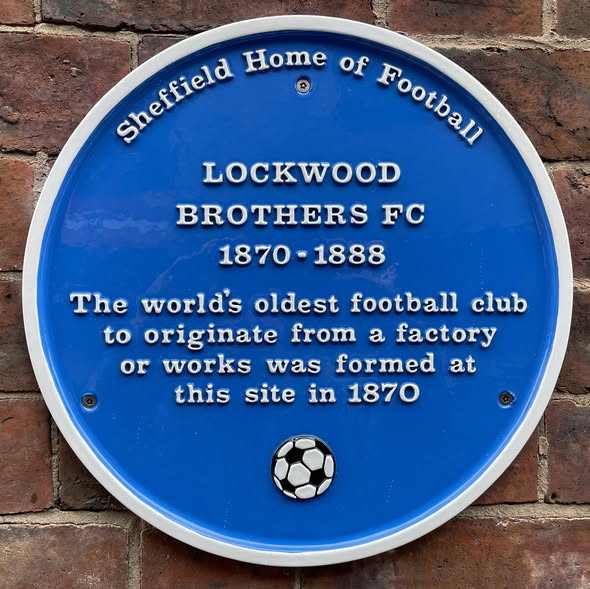
The fashion of clubs emerging from places of working-class employment, supported by the works owners, started to explode during the 1870’s & 80’s especially in areas such as Sheffield, Dumbartonshire & Lancashire. Lockwood Brothers works, during the 1870’s, was on Arundel Street in Sheffield. The club played locally at a now lost ground, called Hunters Bar, which is now Hallamshire Lawn Tenis Club. Lockwood Brothers FC started playing local clubs such as Heeley Victoria, Broomhall and Dore during the 1870’s, but emerged into the 1880’s as one of Sheffield’s top teams.
They won both the highly prestigious local cups during the 1883 – 84 season. These being, the Sheffield Challenge Cup and the Wharncliiffe Charity Cup. They repeated their Sheffield Challenge Cup success the following season.
During their mid-1880’s ‘golden era’, Lockwood Brothers FC could beat clubs of the calibre of Middlesborough & Nottingham Forest. Lockwood’s most significant year happened during the 1886-7 FA Cup. The Wednesday (forerunner to Sheffield Wednesday FC) forgot to apply in time to enter the FA Cup that season and Lockwood Brothers FC, already a decent side, which became even stronger with the inclusion of four Wednesday players, including the legendary England international Billy Mosforth.
Lockwood Brothers played a significant part in the transitional professional-amateur hybrid era when Sheffield’s football culture evolved and challenged the old order, transforming an elite middle-upper class sport into the people’s game. They could conceivably have reached an FA Cup final in 1866/7, but for a dubious refereeing decision against them against West Bromwich Albion, which did reach the final. The secret of their success was to pay the wages of injured players (up to 30 shillings), despite being amateur and refusing to play against Lancashire clubs.
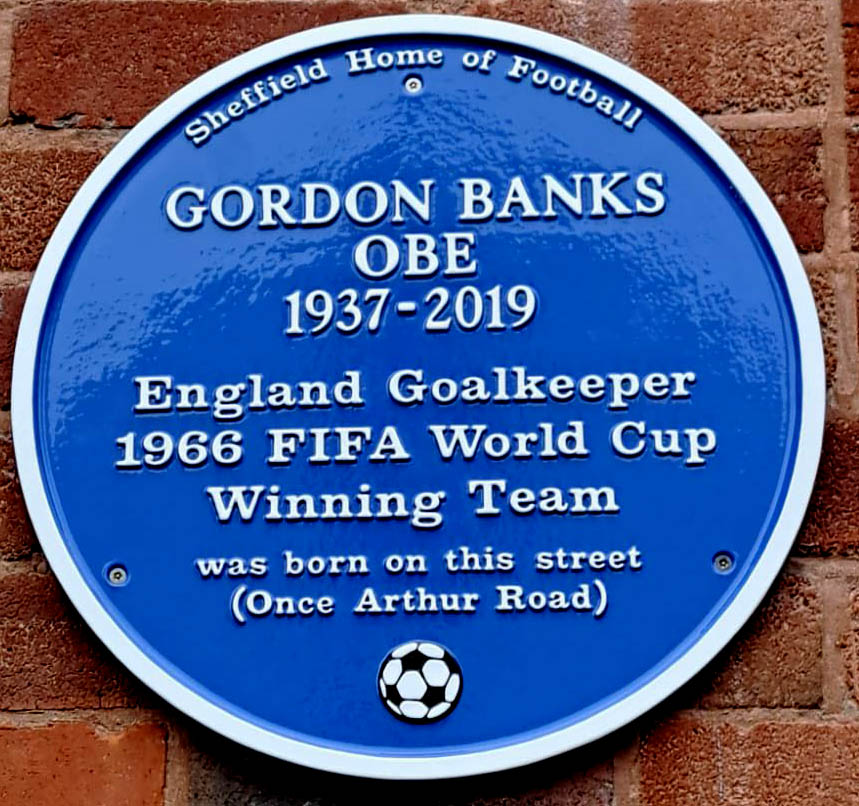
Anyone who was lucky enough to hear Gordon Banks tell his remarkable story in his own words will confirm that he was not only one of the finest goalkeepers in football history but a marvellously charismatic and hugely entertaining public speaker.
This was only one of his many attributes. His singing was described as melodious and spiritually uplifting, and when he joined Leicester City in 1959, he was credited with raising spirits with his early morning rendition of a hit song from 1958 ‘Sugar in the Morning’
In a nice symbiotic link between our 10th plaque launch last week celebrating Lockwood Brothers, the first works football team and plaque 11, Gordon played for a Sheffield works team, Millspaugh as a teenager.
Sometimes hard labour can transcend the impact of a gymnasium and Gordon credited his remarkable upper body and hand strength to humping coal sacks on to lorries.