Strange But True
The Solicitor’s Office where the earliest rules of modern football were written down is (after 167 years) still a Solicitor’s Office.
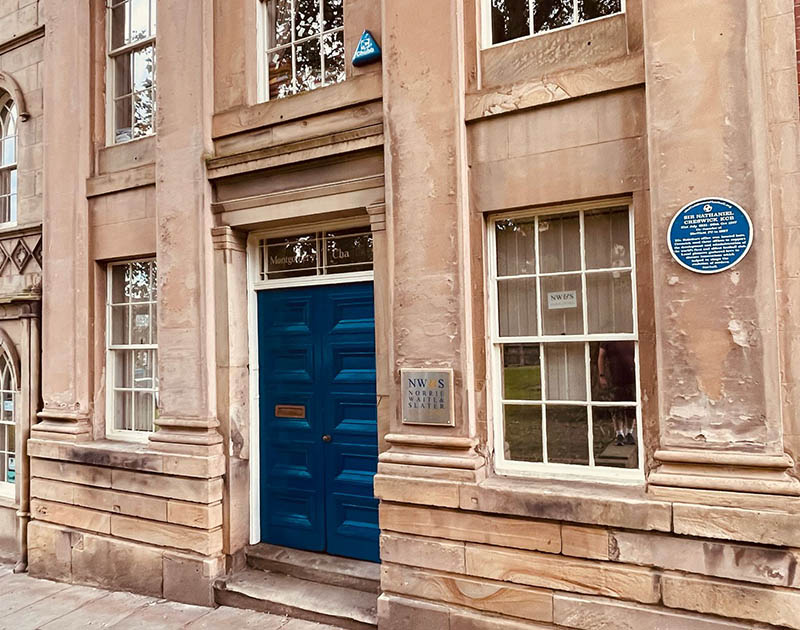
9 East Parade was on 9th October 1858 the small solicitor’s office of Pashley & Creswick’s Solicitors located in the centre of the then northern English town of Sheffield. On that day we know the earliest rules of modern football, the very first version of the Sheffield football rules were written down. These embryonic rules of the modern game were to be formally agreed & approved by Sheffield FC’s club members a few weeks later on 28th October 1858 at the meeting to be held at The Adelphi Hotel, now the Crucible Theatre.
9 East Parade still survives today. The building has incredible & important historical significance. It is simply the earliest known building on the planet used to administer modern football. Creswick, as Sheffield FC’s first Honourable Secretary used the offices at 9 East Parade to hold meetings as well as to write letters to other local clubs and footballing individuals to organised some of the world’s earliest modern football matches. The surprise is that even today the office space survives as it did in 1858, and it is still after all these years host to a solicitor’s office, Norrie-Waite & Slaters.
The 2 earliest locations on earth where modern football was played are now both B&Q car parks
Sheffield FC, the world’s first and oldest association football club started life at the East Bank Ground which is now largely the car park of the Queens Road B&Q in south Sheffield. We know that Sheffield FC played soldiers at Hillsborough Barracks at least 4 times between December 1858 & December 1860. The later of these games were played at The Queens Ground but we believe the first was played on the exercise grounds of the barracks which is now largely the car park of the Penistone Road B&Q in north Sheffield. The red X indicates where the exercise grounds were on the old photo. This means the 2 very first locations to play modern football anywhere in the world are both now the car parks of Sheffield’s 2 B&Q stores.
 The FA wanted to abolish itself after just 3 years of existence:
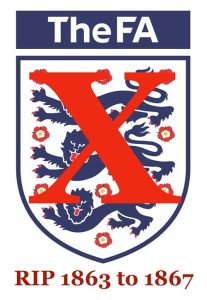
The first 3 years of the new London based Football Association’s life was a complete disaster. Very few clubs wanted to play their 1863 rules & the FA did little to promote its new dribbling, ‘rugby with feet’ game leaving it to struggle in second place alongside various other more popular handling football codes. By 1867 The FA had only 10 clubs left affiliated to it & only 3 of these recorded playing any match by FA rules during 1867. So disappointing was the FA’s fledging era that on the 12th of February 1867 at their AGM only 6 clubs attended. On the agenda was added a resolution to dissolve themselves and basically give up.
Fortunately, Sheffield’s William Chesterman had decided to attend this AGM in person. He came with tales of a thriving northern football culture, a newly formed regional Sheffield FA and a brand-new cup tournament which proved to attract thousands of paying customers (Youdan Cup). We know the outcome. The FA decided to carry on, but it still took nearly 5 more disappointing years for Charles William Alcock to create the FA’s first competitive tournament, the FA Cup in late 1871. The eventual success of the FA Cup ensuring the long-term survival of the football Association during the 1870’s and beyond. Inter association matches as well as international football all helped to secure the future of the game as well as the FA.
It took a Scottish club to fully unify the rules of association football
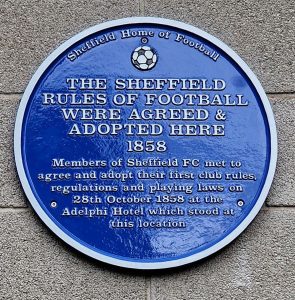 Before April 1877 TWO codes of football existed in the game of association football that by that point co-existed alongside each to become almost identical but not the same. The London FA rules & The Sheffield FA rules. In early 1877 Glasgow club Clydesdale FC suggested a compromise rule change affecting the way the ball was played back into play from side touch. This meant both codes had to accept the ball could be thrown back into play in any direction from side touch as it is today. At the time just one hand was used to throw the ball back into play.
Prior to this the FA rules stated that the ball must be returned at a set right angle to the line & the Sheffield rules kicked the ball back in at any angle. This accepted rule change to both codes resulted in both sets of rules effectively becoming merged & jointly amalgamated into the unified association code we have to this day. We don’t today play by just the FA rules that started to develop from December 1863. We play today by a combination of London FA & Sheffield FA rules that started to develop from October 1858 onwards. 1858 is association football’s birth date NOT 1863, but it took a Scottish club to establish full unity. Complete British & International rules unity soon followed this landmark moment for football.
The same club that invented the corner kick also scored the world’s very first ever golden goal
On 23rd February 1867 at Norfolk Park, Sheffield, Norfolk FC & Broomhall FC played a second-round match during the world’s very first ever association football tournament The Youdan Cup. After 90 minutes the score was nil-nil. The tournament rules allowed another hour to be played with the first team to score declared the winners. Two minutes into extra time Norfolk scored victorious making them the world’s first scorers of a golden goal. Just a year later the same club (Norfolk) invented the corner kick which became part of The Sheffield Rules of football in 1868.
A similar golden goal rule was used the following year during the world second oldest association cup tournament, the Cromwell Cup of 1868. This was also played under Sheffield Rules and during the final at Bramall Lane, the deciding goal was scored during extra time by the then newly formed The Wednesday (now Sheffield Wednesday).
The night the European Cup was “stolen”
In 1982 Aston Villa players Colin Gibson and Gordon Cowans took the recently won European Cup trophy into the Fox Inn in Tamworth to show it off. While the players were playing darts, a regular at the pub, Adrian Reed decided it was a good idea to take it while nobody was looking. Realising what he had done, and fast becoming the most wanted man in Europe, Reed decide up to Sheffield and declaring himself as Eric Sykes, walked into West Bar police station and said he had the European cup in the boot of his car. Next thing he walked out and reappeared with the famous cup complete with claret & blue ribbons on.
Whilst waiting for West Midlands Police to come and collect the trophy, South Yorkshire’s finest decided to hold a football match for the cup. They picked two teams and in the middle of the night, in full uniform, played a match. One of the faces in the photo is former Sheffield Wednesday goalkeeper Peter Springett, who became a police officer after retiring from the game.
The story remained a guarded secret for nearly 30 years, only coming to light in 2010 when West Bar police station was being cleared out for closure. Photographs from the night were found and brought out at a farewell event for the station. No charges were ever brought against Reed for the theft. Everyone apparently agreed to keep the evening’s events a secret. Sadly, it is thought Adrian Reed died in a car crash some years ago.
Maradona could have played for SUFC
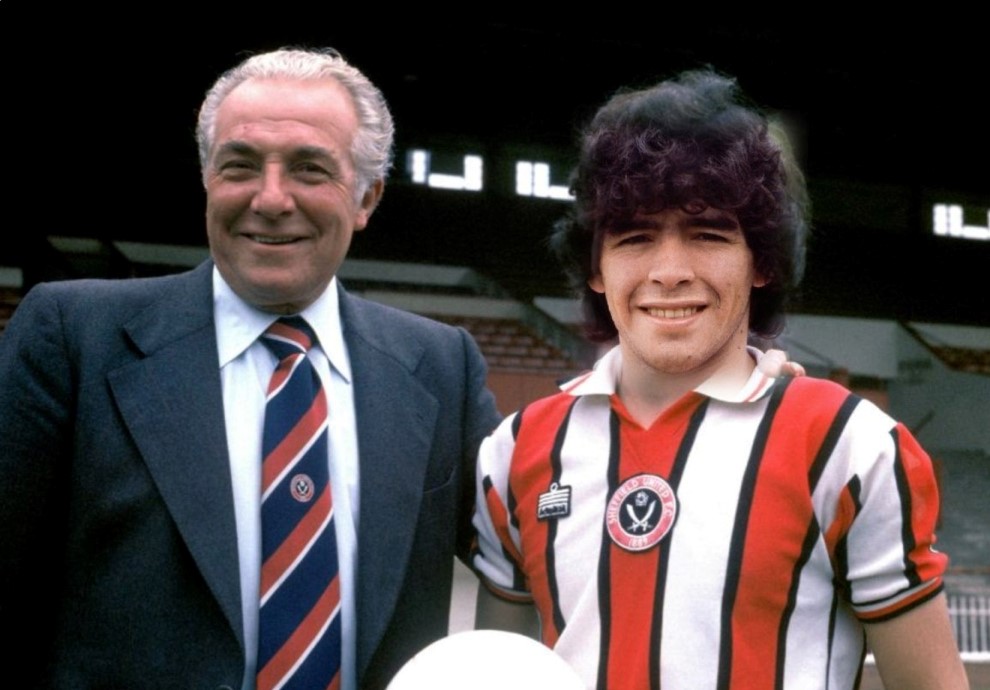
Maradona at aged 17 in 1978 was all set to sign for Sheffield United FC. The club initially agreed to pay £200,000 but back out when the fee strangly doubled to £400,000. Instead, they signed Alex Sabella. United missed out on having one of the greatest players in football history on their books. Imagine if Bramall Lane had witnessed Maradona’s magic instead of Barcelona or Naples.
Within a few months clubs were buying players for over a million pounds so £400,000 was actually still a bargain but hey!! The value of hindsight!!
DiCanio’s Antics
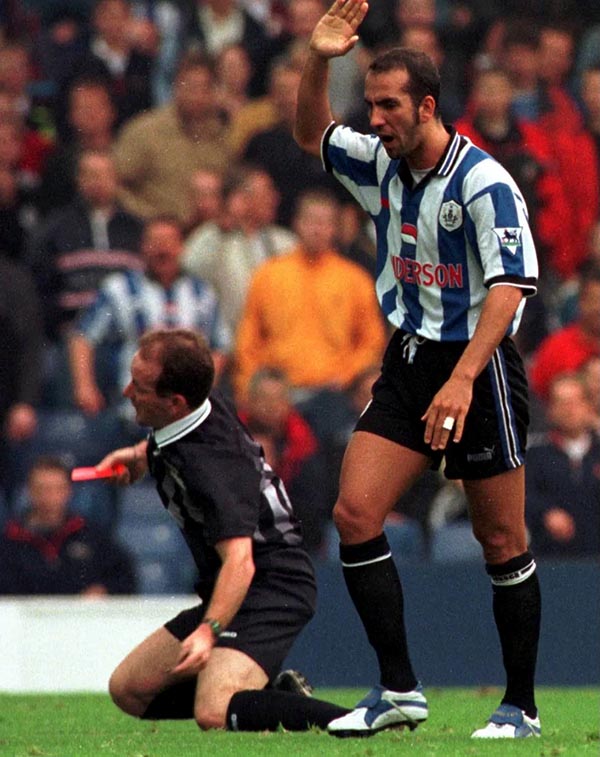
While playing for Sheffield Wednesday vs Arsenal on 26th September 1998, 43 minutes into the game Di Canio became embroiled in a scuffle with first Patrick Vieira & then Martin Keown, things escalated, other players got involved. & the inevitable happened, referee, Paul Alcock, beckoned the Italian over to him, & issued (justifiably) a red card.
Di Canio’s response, walk to the tunnel? NO! Instead, disbelieving fans witnessed Di Canio pushing Alcock with both hands into his chest. This was followed by the most bizarre backwards fall by Alcock as he “stumbled” backwards to eventually to the ground. The whole episode was completely “bonkers” and as far as I am aware never been seen before or repeated since on a football pitch.
Di Canio was banned by the FA for 11 games. He would never play for Sheffield Wednesday again.
I was home players tunnel & dug out steward that day and not far from the whole incident. Keown also got a red & it’s “rumoured” that Di Canio & Keown’s antics continued down the tunnel. My lips are sealed. Wednesday won the match 1-0 with a late Lee Brisco wonder goal.
Christmas Comes Early for Sheffield United.
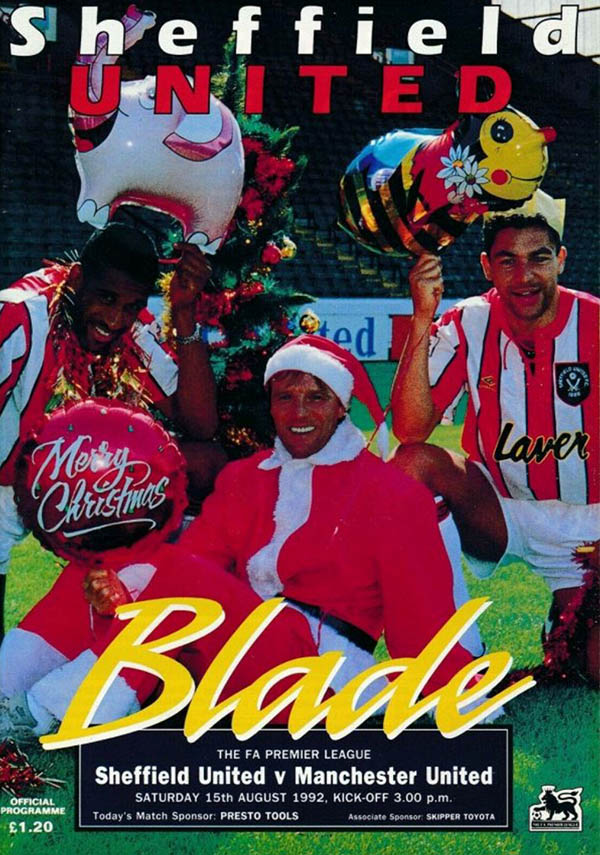
In 1992, the Premier League as we know it came into existence. One of Sheffield’s claims to fame is that the first ever Premier League goal was scored by Brian Deane of Sheffield United in a match versus Manchester United on the inaugural match day.
What is bizarre about that historic day was the image used on the programme cover – a festive theme in August.
It turns out that this was actually an inside joke. Critics said that United would be unable to win a match before Christmas, so manager Dave Bassett threw the team a festive party in the summer to up their form at the start of the season. The Chrismas pudding worked for Brian at least.
Tales supplied by Steve Wood