The Mackenzie clan which hail from Kintail and Ross-shire in the Scottish Highlands seem to have developed a fondness for Sheffield and the Northeast Midlands because there are families across the region. The official Sheffield Tartan (yes, we have one, although I can’t confirm it was granted because of our invention of the passing game, later beloved and enhanced by many early Scottish teams) has some similarities to the Mackenzie Tartan.
In 1805 Alexander Mackenzie was minister of St Paul’s Pinstone Street. One of his son’s William Bell Mackenzie (1806-70) was very active in Sheffield society. In both Sheffield, Rotherham and Worksop, Mackenzie’s feature in the history of organised football, and there were family links with the Riley’s who owned the Garrick Tavern. Some people may recall Ian Mackenzie who played for Sheffield United in the 1970’s.
Running three teams as early as 1863, when (sir) Nathaniel Creswick judged the annual athletic competitions at Bramall Lane and peaking at 500 members in 1868, the Mackenzie Cricket and Football Club, were, for a time, one of the best teams in the city. Pretty in pink, with white shorts and wearing plaid caps in deference to their Scottish roots, they must have looked pretty good on the dancefloor too!
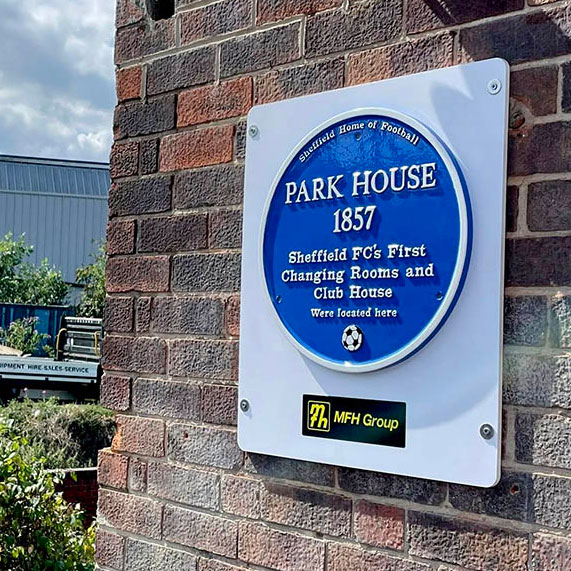
An old gennel links Pear Street and Mackenzie Street, not far from where we placed our first plaque on the Nuffield health building, home of the world’s first football team to evolve from a church, Cemetery Road Church FC. Mackenzie and Cemetery Road FC was a very early ‘derby’ with only yards separating the home territory of the two clubs. The clubs met in 1861 with Mackenzie winning by a goal and a rouge.
A pub called the Mackenzie tavern, the house of Mr Thomas Armeson once slaked Victorian thirst here, but it does not appear to have been the headquarters of what was once a fashionable and extremely well-funded club, judging by the £60 worth of prizes offered (over 10k in today’s money, a remarkable sum) for athletics. Prizes included dram flasks, time pieces and expensive silver ware. A Mackenzie Crescent which existed in Broomhall would more accurately reflect the affluence of the club and may have links.
The ‘Mackenzi-ites’ as christened by the local press, were founded at Mr Henson’s confectioner on the moor and had their headquarters, for the early years, either at the George Hotel on George Street, which is now called Boston Street, or at the Sportsman Inn, Thomas Street.
The Football Annual lists them as playing continuously at Myrtle Road but this is not evidenced in match reports. They are recorded as playing at Sky Edge and East Bank in 1863 and at the Cremorne ground in 1866. In the Youdan cup a year later they beat Garrick at the orphanage and Milton at the same venue (although that is described as the ground of the latter). In the early 1870’s Myrtle Road becomes known as the Mackenzie ground and is used more consistently in the subsequent decade.
One claim to fame is that Mackenzie invented arguably the most eccentric event registered in the ubiquitous sports days held at Bramall Lane by the more reputable clubs. A120yd race where two men wearing one pair of trousers competed. They had to race running backwards and forwards and this was billed as ‘the Mackenzie sensation.’ It was probably extremely painful.
Because they did not evolve into an FA Cup team and nor compete successfully for subsequent Sheffield Challenge Cups, Mackenzie never reached the dizzy heights of tactical innovation they aspired to as one of the biggest clubs in the city, in1868. Probably their biggest contribution to the Sheffield game was helping Sheffield Club experiment with the new offside rules in 1865.