FOUNDING OF THE FA
It is well known that Sheffield FC formed in 1857 and may have felt alone in Sheffield, apart from a few games against the military at Hillsborough Barracks, until the Hallam club formed in 1860. However, the spark in Sheffield in 1857 had set the flame that became the fire for the establishment of the modern game of football in England, Britain and the Rest of the World.
London and its suburbs were also getting on board with four London-based clubs being formed before Hallam, and over 40 football clubs forming across England before the end of 1863.
One of the 40+ clubs was Barnes FC, formed by Hull-born Ebenezer Cobb Morley in 1862 at his London rowing and rugby club. Morley was so passionate about the football game that he wrote to Bell’s Life in 1863 to propose an “association be formed to oversee the governance of the game and establish a common code”. He got his wish!
26th October 1863
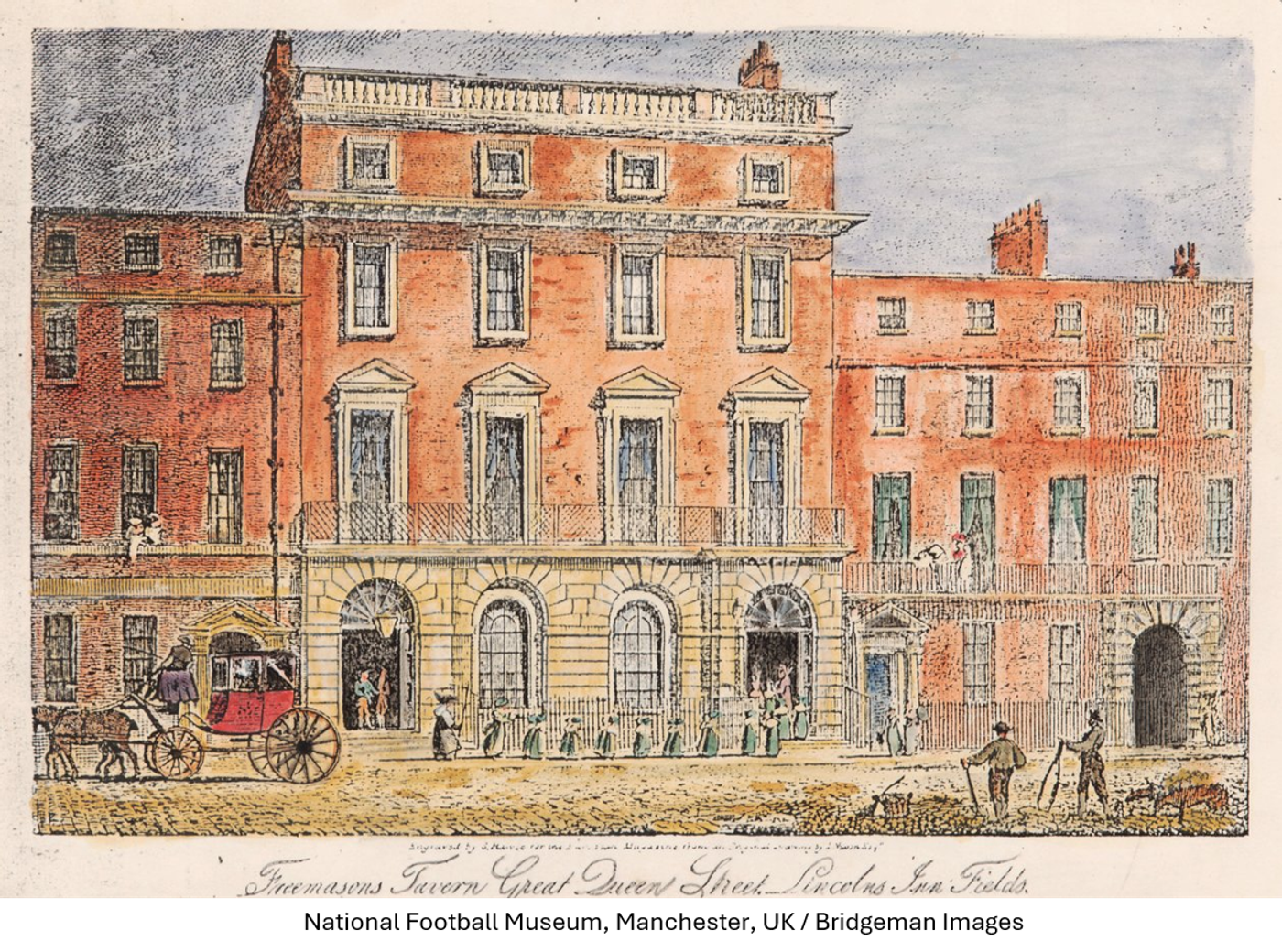
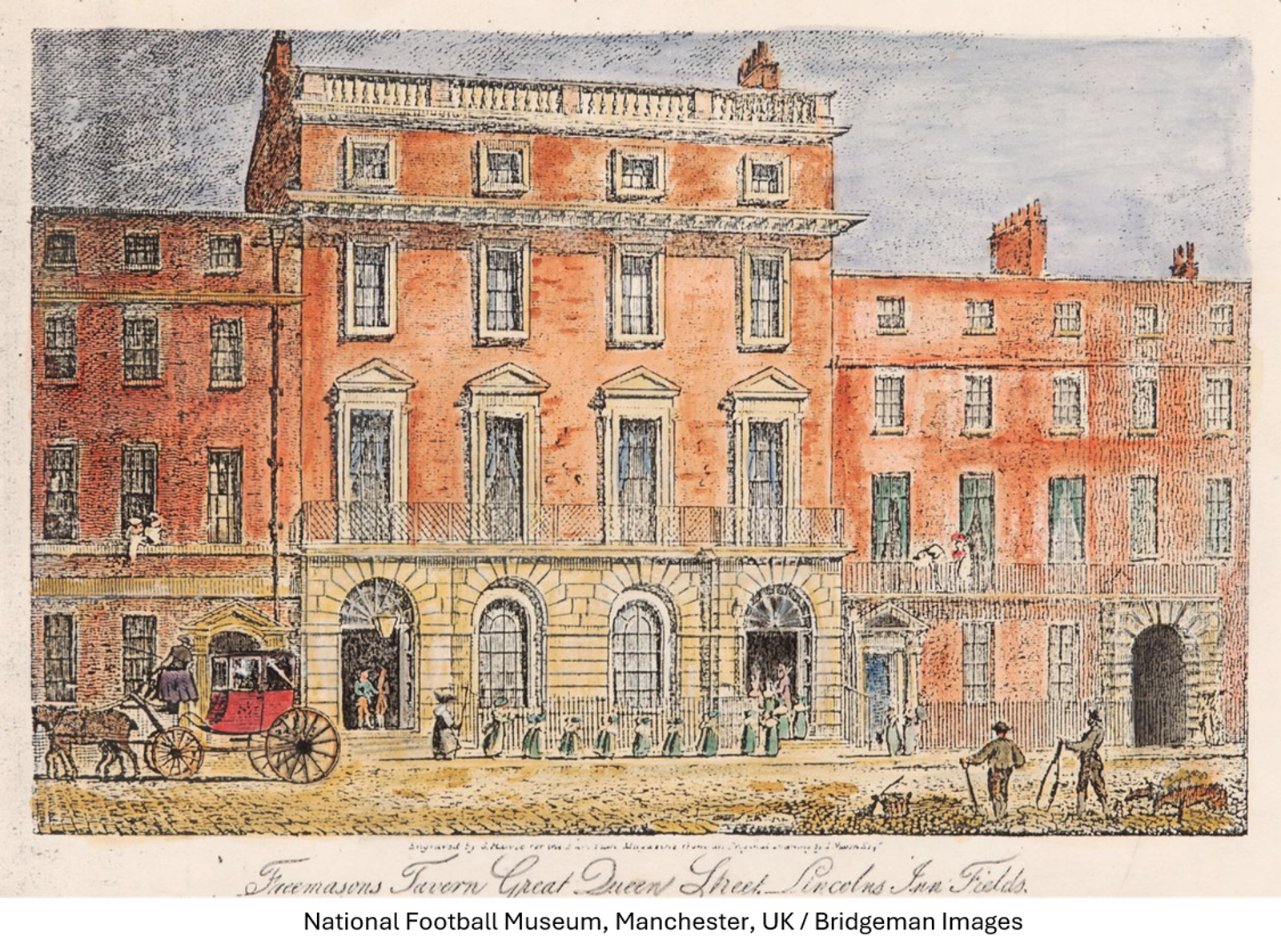
When the inaugural meeting of what was to become ‘The Football Association’ met on a Monday evening on 26th October 1863 at the Freemasons’ Tavern on Great Queen Street there were at least 15 football clubs known to be in existence in the London area (and there were at least 25 in the Sheffield area and others in Lincolnshire, Staffordshire and Lancashire). The London clubs were invited to attend the inaugural meeting at the Freemasons’ Tavern (however, it should be noted that several other clubs sent observers but no club outside of London was invited). Clubs attending this 1st meeting:
Barnes FC - 2 delegates
Blackheath FC - 2 delegates
Blackheath Proprietary FC - 1 delegate
Blackheath Percival House FC - 1 delegate
Forest FC - 2 delegates
War Office (Civil Service) FC - 1 delegate
Crusaders FC - 1 delegate (did not attend subsequent FA meetings)
Surbiton FC - 1 delegate (did not attend subsequent FA meetings)
No Names Kilburn FC - 1 delegate
Kensington School FC - 1 delegate
Crystal Palace FC - 1 delegate
Charterhouse FC (1 delegate) attended but did not to join the FA.
Dingley Dell FC, Royal Engineers FC and Mincing Lane FC did not to attend the meeting.
The following attended subsequent meetings:
Royal Naval School FC (Meeting 2 and 3)
Forest School FC (Meeting 5)
Wimbledon School FC (Meetings 4,5 and 6)
John Lillywhite attended Meeting 6
This Football Association met six times between 26th October and 8th December to try to establish the membership and to set out common laws for the game of football. Sheffield FC closely tracked the meetings of this Football Association, including sending Harry W Chambers to this inaugural meeting as an observer.
1st December 1863
This has been described as the ‘Fifth Founding Meeting’ although the fourth meeting had been adjourned due to the three Blackheath clubs rejection of any rules that did not allow hacking, handling and charging. The previous meetings had been held on each Monday following the initial meeting on 26th October.
Most significantly, at the 1st December 1863 meeting a letter was read out from William Chesterman, Secretary of Sheffield FC (letter published in the Sporting Life at the time) which submitted Sheffield FC’s registration fee to join the FA but to strongly argue against the hacking, handling and running with the ball as these were “directly opposed to football” and stating “I cannot see any science in taking a running kick at a player at the risk of laming him for life!”.
This fifth meeting only had seven of the original subscribed clubs in attendance. It did however attract greater vocal input from teams outside of London, particularly Sheffield, Lincoln and Louth focused on the Rules of the Game and a major debate that led to the hacking and handling rules to be removed.
8th December 1863
On Tuesday, 8th December at 7pm at the Freemasons’ Tavern, the ‘Sixth Meeting’ of The FA was held. This meeting was significant in that 13 Laws of the Game were agreed. These being:
Law 1, The playing ground and goals - The maximum length of the ground was 200 yards and the maximum width was 100 yards. The boundaries were marked with flags. The goals consisted of two upright posts, eight yards apart, with no crossbar or tape connecting them.
Law 2, Starting the match – The teams tossed for the choice of goals. The team losing the toss kicked off from the centre of the ground using a place kick. The opposing team had to remain at least 10 yards from the ball until it was kicked.
Law 3 , Restarting after a Goal – After a goal was scored, the team that had conceded it was entitled to kick off. The teams also changed ends after every goal.
Law 4 , Scoring a Goal – A goal was scored when the ball passed between the goalposts or through the space between them, at any height, provided it had not been thrown, knocked on or carried through.
Law 5 , The ball going out of play – When the ball went out of bounds, the first player to touch it had to throw it back from the point where it crossed the boundary. The throw had to be made at right angles to the boundary line, and the ball was not in play until it touched the ground.
Law 6 , Offside – When a player kicked the ball, any teammate nearer to the opponents' goal line than the ball was considered out of play. That player could not touch the ball or interfere with another player until back onside.There was an exception when the ball was kicked from behind the goal line.
Law 7 , When the ball went behind the goal line – This law established different procedures depending on which team touched the ball first after it crossed the goal line.
1. If a player from the defending team touched it first: A teammate received a free kick from the goal line, opposite the point where the ball had been touched.
2. If an attacking player touched it first: A teammate received a free kick from a point 15 yards outside the goal line, opposite where the ball had been touched. The defending team had to remain within its goal line until the kick was taken.
Law 8 , The fair catch – A player who made a fair catch was entitled to a free kick, provided they immediately marked the spot with their heel. The player could retreat as far as desired to take the kick, and opponents could not advance beyond the mark until the kick had been taken.A fair catch meant catching the ball after it had touched an opponent or had been kicked or knocked on by an opponent, before it touched the ground or another player on the catching side. A fair catch could not be made from a ball kicked behind the goal line.
Law 9 , No running with the ball – No player was allowed to run with the ball.
Law 10, No tripping, hacking, holding or pushing – Tripping and hacking were prohibited. Players were also forbidden from using their hands to hold or push opponents.
Law 11 , No throwing or passing the ball with the hands – A player was not allowed to throw the ball or pass it to another player using their hands.
Law 12, No picking up the ball – Players were not allowed to take the ball from the ground with their hands while it was in play.
Law 13 , No dangerous projections on boots – Players were prohibited from wearing projecting nails, iron plates or gutta-percha on the soles or heels of their boots.
A new Board was appointed to oversee the FA with Arthur Pember (President) and Ebenezer Cobb Morley (Secretary) and the rest of the committee remained very much London based. The FA Rules were finally published in a booklet that cost a shilling and sixpence.by John Lillywhite (who attended the 6th meeting). 8th December 1863 is really when the Football Associate was established.
The FA was keen to see its laws in action and it was actually what happened after the 6th meeting that is significant in the development of the Laws of the Game and the establishing of the FA.
12th December 1863
Barnes FC play Forest FC – Forest won 1:0 but there was much dispute about the rules, however Forest FC declared that they would play to the new rules for all future games “not already arranged”.
19th December 1863
Barnes FC play Richmond FC at Mortlake with 15-a-side using the new rules. A 0-0 draw was seen as a success for the Rules but interestingly Richmond FC would never joined the FA.
2nd January 1864
A representative test game took place between President’s Select Team v. Secretary’s Select Team at Battersea Park. It was 14-a-side and the Presidents Team won 2:0 (Charles W Alcock scored both goals). Harry W Chambers from Sheffield FC played for the President’s team in the game and was reported as “a most excellent player”.
President’s Team: A Pember, CW Alcock, HW Chambers, AM Tebbut, Gray, Drew, RG Graham, WJ Cutbill, A Morten, J Turner, Morris, Renshaw, Leuchers, A Scott
Secretary’s Team: EC Morley, JF Alcock, CM Tebbut, A Lloyd, C Hewitt, GT Wawn, JP Phillips, Innes, McCalmont, Needham, H Baker, AJ Baker, Hughes, Jackson
Despite the matches played, the FA Rules were reluctantly used within London, whilst in Sheffield and across the other towns of England they were not followed. Sheffield FC continued to actively participate in the FA and in the development of the FA Rules, whilst at the same time honing what had become known as the ‘Sheffield Rules’ and was now used by most teams in the Sheffield area.
Subsequent FA meetings in brief
The FA did not formally meet again until 26 October 1864; there is not record of an official meeting in 1865; and they met again on 22nd February 1866. This latter meeting looked at rule changes including offside and handling. They also discussed an invitation from Sheffield FC for an inter-city match to be played March 1866 between a London representative side and Sheffield FC. The FA agreed if the match was played at Battersea Park under FA Rules. London won 2 goals/4 touchdowns:0/0 and Sheffield returned home to consider the implications.
By the next official FA meeting in February 1867, the FA was considering disbanding as membership had fallen badly. Sheffield FC’s Harry W Chambers sent a letter to inform the FA committee of the considerable development of the game in Sheffield and the Youdan Cup tournament and as a consequence, no vote to disband was called.
The FA galvanised off the back of this 1867 meeting, though Charles W Alcock writes “On January 1, 1868, the FA now had twenty-eight members. These were the Amateur Athletic, Barnes, Bramham College (Yorks), Charterhouse School, Civil Service, C.CC. (Clapham), Cowley School (Oxford), Crystal Palace, Donington Grammar School (Lincolnshire), Forest School (Walthamstow), Holt (Wilts), Hull College, Hitchin, Kensington School, Leamington College (Warwicks), London Scottish Rifles, London Athletic, Milford College (South Wales), N.N.s (Kilbum), Royal Engineers (Chatham), Reigate, Sheffield (Yorks), Totteridge Park (Herts), Upton Park, Wanderers, Westminster School, West Brompton College, and Worlabye House (Roehampton).” There were circa 80 clubs formed in the UK (including in Scotland and Wales).
The Sheffield FA was established in March 1867 following the Youdan Cup football tournament and the game in the Sheffield area exploded with over 200 clubs formed by 1877.
Click here for more Part 2 of the Formation of the FA 26th February 1866.
Click here for more information about the 31st March 1866 Match at Battersea Park.
Click here for more information about the Establishing of the Sheffield FA 6th March 1867.
Click here for more information about the Youdan Cup Spring 1867.
Steve Ingall
SHOF Guided Walks Coordinator
email: SHOF.WALKSandTALKS@gmail.com