
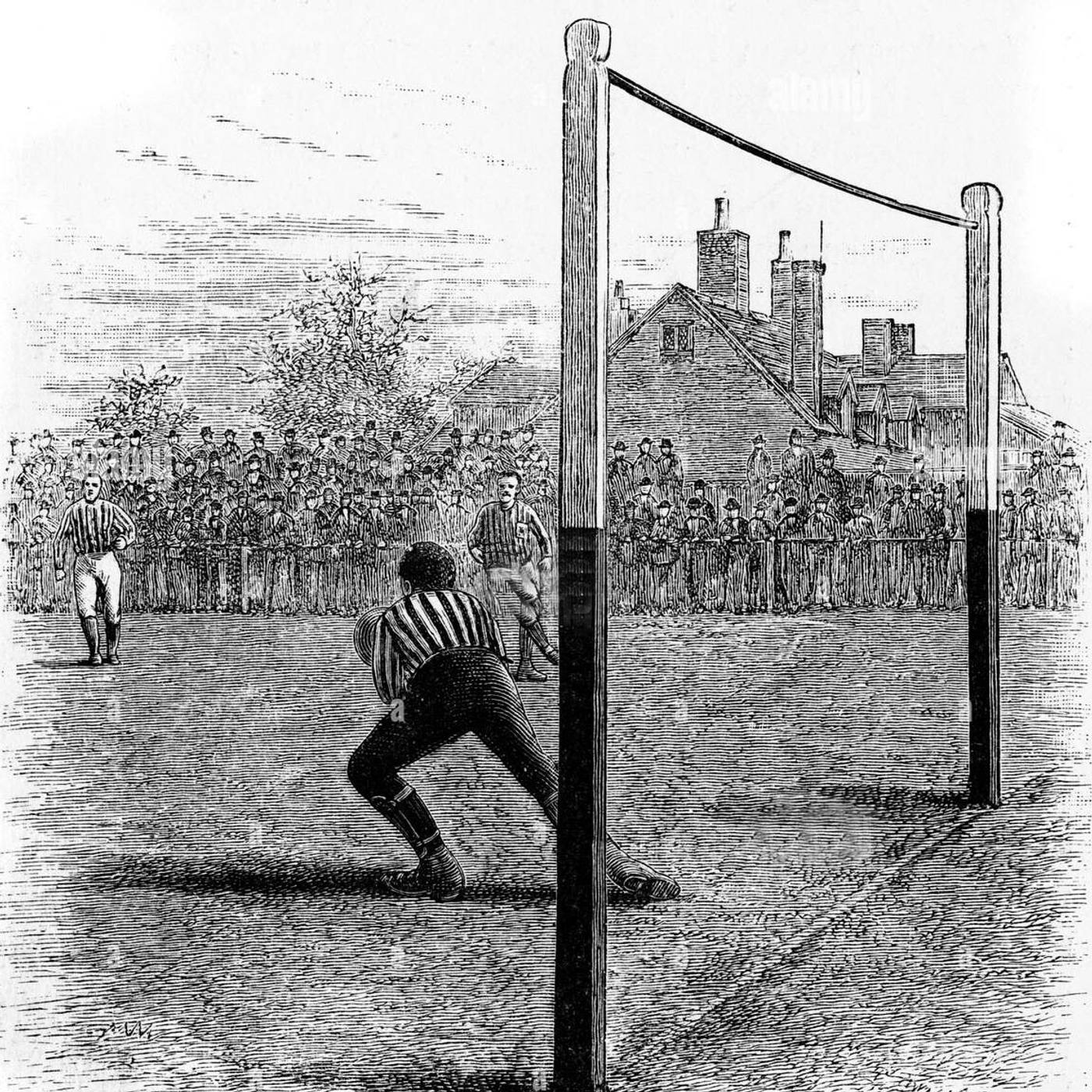
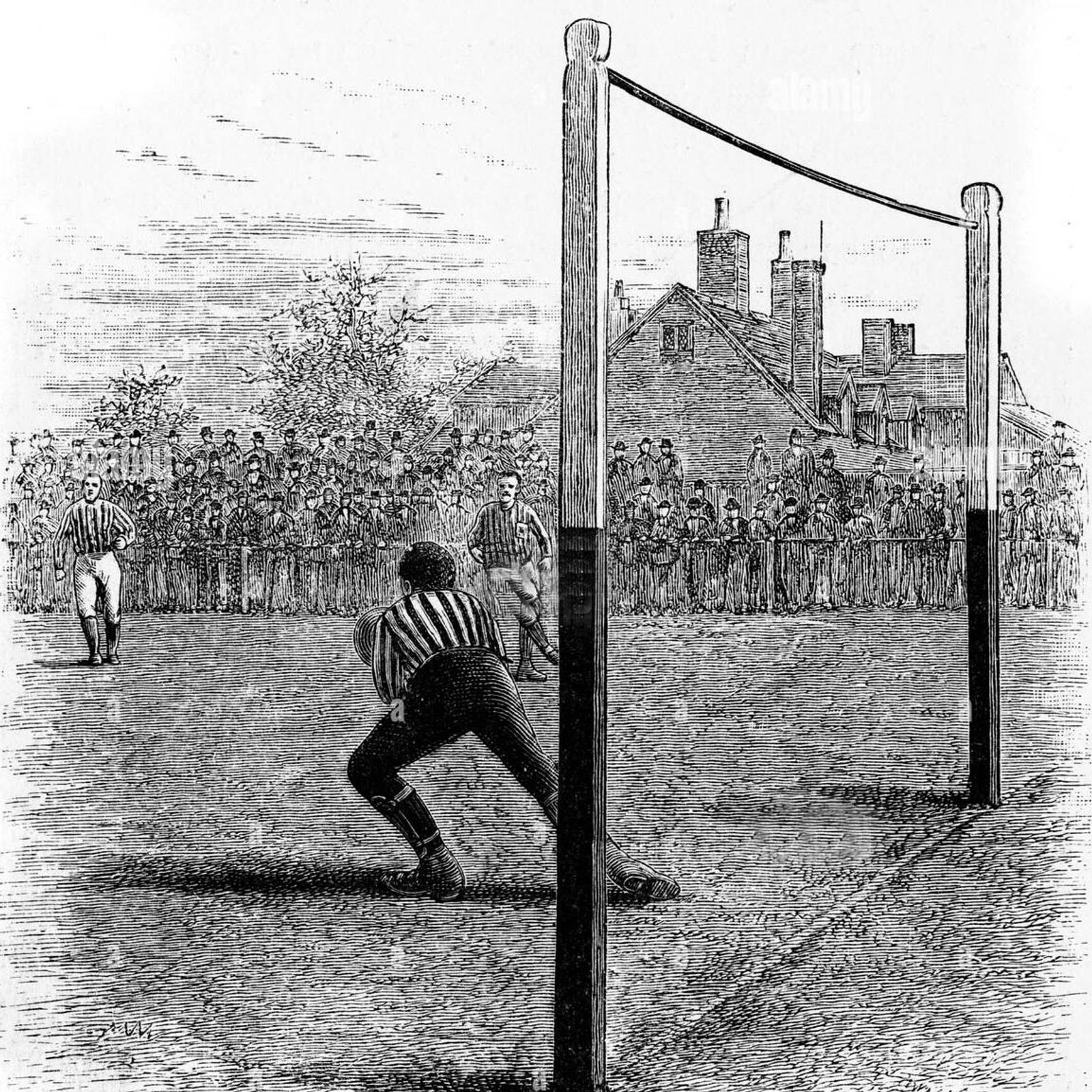
A brief history of the Goal Mouth/shape
To win a game of association football you must score at least one goal more than your opponents. A goal being define as the ball going between two goal posts, under a crossbar and fully over the line between the posts. Simple when you think about it.
All games with balls throughout history have had some form of scoring. The ancient Chinese scored through holes in cloth. Folk games in the Middle Ages used fixed points such as churches, doors or even gates as scoring markers. In other games the ball going over a rope or over just a line was a score. In 1681 a match involving the King’s servants actually used the doorways of two separate forts as goal mouths. The word goal apparently comes from a late 1500’s Cornish hurling style game. The aim in the game was to get a small silver ball between two bushes to score. The bushes were for the game called “goales”. The term must have stuck.
We stated to see the emergence of posts as goal markers from public school games in the mid 1800’s. The Eton Field Game Rules of 1847 described having goals of 11 feet wide and 7 feet high but without any string, rope or anyway of measuring if the ball had gone higher than the “goal sticks”. If the ball went above 7 feet it wasn’t a score. I guess part of the umpiring relied on gentlemanly trust & fair judgment.
Thring’s Uppingham School rules of 1857 described goals of posts 20 feet apart, 7 feet high & marked by a rope at the top. Thring went to Shrewsbury School in the 1830’s & 1840’s and was probably influenced by their very wide goals marked onto walls of reportedly 40 feet wide and with unlimited height. You could handle and run with the ball in the Uppingham game, but you had to kick a goal through the posts to gain a score. We continue to get closer to a modern football goal shape when studying the goal as described in the Cambridge rules of the late 1850’s (dated claimed 1856).
Rule 7 states: “Goal is when the ball is kicked through the flag posts and under the string.”
We have no record I am aware of describing how far apart these goal ‘flag posts’ were but the 1863 Cambridge rules state a distance of 15 feet so we can assume the late 1856 goal mouths at Cambridge were of a similar width. We don’t know the height of the string, however. The interesting thing about the Cambridge rules is they had a form of crossbar (string) in the late 1856 but didn’t by late 1863. The Cambridge 1863 rule 12 states: “A goal is obtained when the ball goes out of the ground by passing between the poles, on in such a manner that it would have passed between them had they been of sufficient height.”
The implication here seems to suggest the ball needs to be at least off the ground and there is no height limit so a move away from what we now regard as the standard goal shape of posts and a crossbar between 1856 & 1863 at Cambridge.
Our earliest football goal that most closely mirrors modern football once again comes from Sheffield football. We know that as early as 1861 a goal in a match at Hyde Park Sheffield was described as the ball being ‘headed under the crossbar’ to score a goal for Hallam. The goal posts in Sheffield football were 12 feet apart & the crossbar (written formally into the laws in 1862) was 9 feet from the ground.
Of course, the London FA in 1863 when producing its first set of rules initially took its lead and leaned towards the Cambridge rules of the day by not having a crossbar of any kind. This was probably to appease those favouring a rugby style game among the London clubs, the goal being able to be scored at any height between two posts.
The London FA 1863 posts were 8 yards apart and the laws actually stated there should be no tape or bar across them. In 1866 the London FA finally adopt what we now know as a “modern” style goal with posts of 8 yards apart and a tape 8 feet off the ground acting as the effective crossbar. Their hard fixed crossbar came later.
So, the first modern rules of the game to have an actual modern fixed goal mouth shape that remained as part of the game’s modern rules right up in till the full amalgamation of the Sheffield FA & London FA rules in 1877 was the Sheffield Football Rules, from at least as early as 1861.
For the record, the Sheffield goal became 8 yards wide like the London FA’s in 1868 & 8 feet high again like the London FA’s in 1876 & so was identical to the London FA’s goal dimensions when the full amalgamation of both codes took place a year later.
Do you have more information about this that we could add? Are any of the facts wrong? Please get in touch if so.
Source: Steve Wood